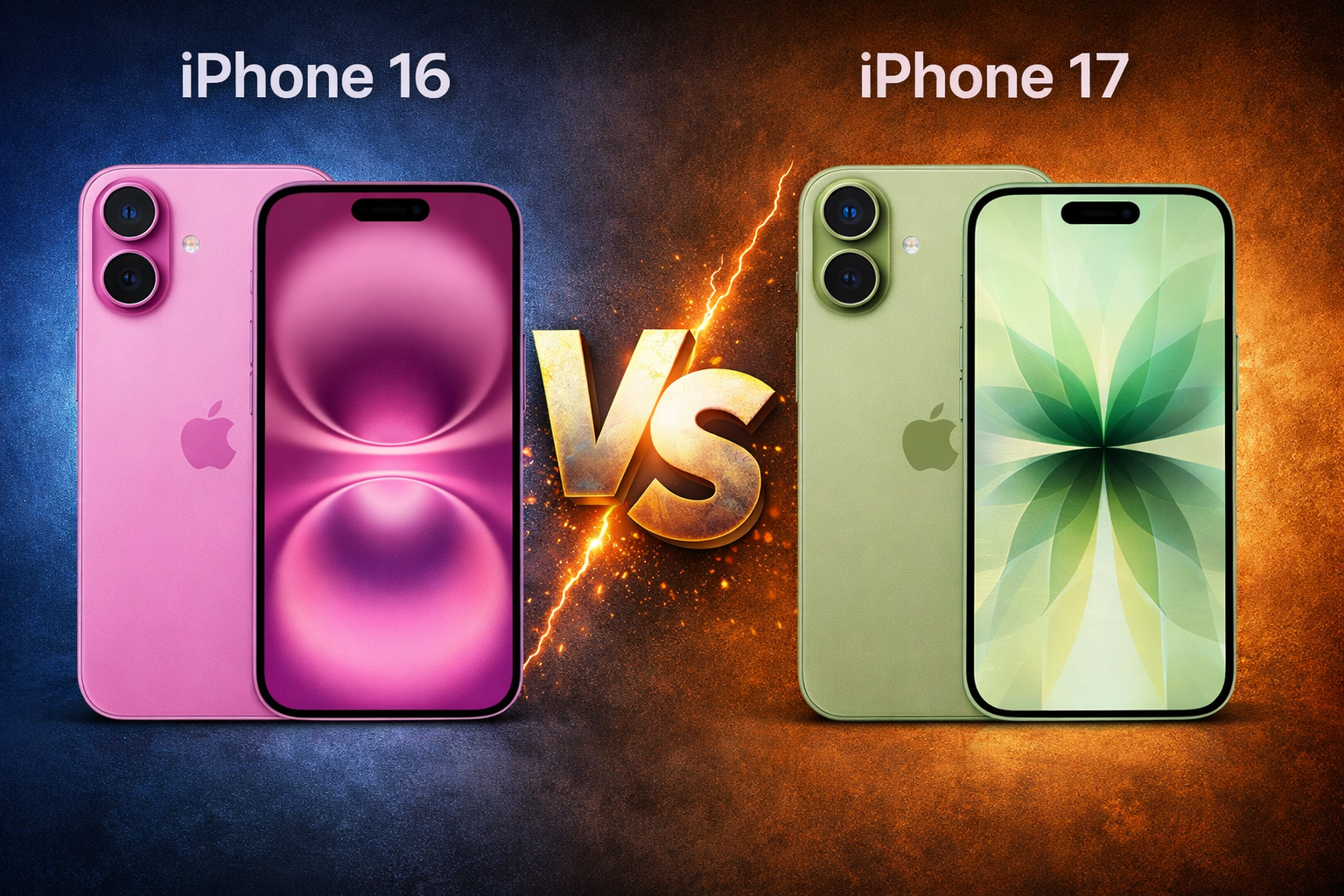
Apple’s generational updates often look subtle from the outside, but the real story usually sits in the specification sheet. The iPhone 17 and iPhone 16 are a good example of this approach. At first glance, they appear nearly identical. When you look closely at the hardware, display, chipset, camera system, and battery architecture, important differences start to appear.
This comparison breaks down the iPhone 17 and iPhone 16 across every major category, using concrete specifications first, followed by what those numbers actually mean.
If you’re choosing across the wider lineup, you can also refer to our Best iPhone to Buy in Australia (2026) guide.
Launch and positioning
iPhone 16
- Announced: September 2024
- Released: September 2024
iPhone 17
- Announced: September 2025
- Released: September 2025
The iPhone 17 is one full hardware generation newer and will naturally sit further forward in Apple’s long-term software support cycle.
Dimensions and build
iPhone 16
- Dimensions: 147.6 × 71.6 × 7.8 mm
- Weight: 170 g
- Build: Glass front (Ceramic Shield), glass back, aluminum frame
- Water resistance: IP68 (up to 6m for 30 min)
iPhone 17
- Dimensions: 149.6 × 71.5 × 8.0 mm
- Weight: 177 g
- Build: Glass front (Ceramic Shield 2), glass back, aluminum frame
- Water resistance: IP68 (up to 6m for 30 min)
The size difference is minimal. The iPhone 17 is slightly taller, thicker, and heavier, mainly due to internal changes and a larger battery.
Display
iPhone 16
- Type: Super Retina XDR OLED, HDR10, Dolby Vision
- Size: 6.1 inches
- Resolution: 1179 × 2556 pixels
- Pixel density: ~460 ppi
- Typical brightness: 1000 nits
- Peak brightness (HDR): 2000 nits
- Protection: Ceramic Shield (2024 generation)
iPhone 17
- Type: LTPO Super Retina XDR OLED, HDR10, Dolby Vision
- Size: 6.3 inches
- Resolution: 1206 × 2622 pixels
- Pixel density: ~460 ppi
- Typical brightness: 1000 nits
- Peak brightness (HBM): 1600 nits
- Peak brightness (outdoor): 3000 nits
- Protection: Ceramic Shield 2, anti-reflective coating
The iPhone 17 introduces an LTPO panel, higher peak brightness, and a slightly larger display, improving outdoor visibility and power efficiency.
Performance and chipset
iPhone 16
- Chipset: Apple A18 (3nm)
- CPU: Hexa-core (2×4.04 GHz + 4×2.20 GHz)
- GPU: Apple 5-core GPU
- OS: iOS 18, upgradable to iOS 26+
iPhone 17
- Chipset: Apple A19 (3nm)
- CPU: Hexa-core (2×4.26 GHz + 4×X.X GHz)
- GPU: Apple 5-core GPU (new generation)
- OS: iOS 26, upgradable long term
The A19 brings higher clock speeds, better sustained performance, and improved power efficiency, particularly under prolonged workloads like gaming, video processing, and AI features.
Memory and storage
iPhone 16
- RAM: 8 GB
- Storage options:
- 128 GB
- 256 GB
- 512 GB
- NVMe storage
- No SD card support
iPhone 17
- RAM: 8 GB
- Storage options:
- 256 GB
- 512 GB
- NVMe storage
- No SD card support
Apple has removed the 128 GB base option on the iPhone 17, positioning it as a higher-tier device out of the box.
Rear camera system
iPhone 16
- 48 MP wide (f/1.6, 26mm, 1/1.56″, sensor-shift OIS)
- 12 MP ultrawide (f/2.2, 120°, PDAF)
- Features: HDR, dual-LED flash
- Video:
- 4K at 24/30/60 fps
- Dolby Vision HDR
- 1080p up to 240 fps
iPhone 17
- 48 MP wide (f/1.6, 26mm, 1/1.56″, sensor-shift OIS)
- 48 MP ultrawide (f/2.2, 120°, PDAF)
- Features: HDR, dual-LED flash
- Video:
- 4K at 24/30/60 fps
- Dolby Vision HDR
- Improved stabilization and processing
The key upgrade is the ultrawide camera, which jumps from 12 MP to 48 MP, bringing a major improvement in detail, cropping capability, and low-light performance.
Front camera
iPhone 16
- 12 MP wide
- HDR, Dolby Vision HDR
- 4K video up to 60 fps
- Face ID
iPhone 17
- 18 MP wide
- HDR, Dolby Vision HDR
- 4K video up to 60 fps
- Face ID
The front camera receives a noticeable resolution increase, improving selfies, video calls, and content creation.
Battery and charging
iPhone 16
- Battery: 3561 mAh
- Wired charging: 50% in ~30 min
- Wireless charging:
- 25W MagSafe
- 15W Qi2
- Reverse wired charging: 4.5W
iPhone 17
- Battery: 3692 mAh
- Wired charging: PD 3.2, 50% in ~20 min
- Wireless charging:
- 25W MagSafe
- 15W Qi2
- Reverse wired charging: 4.5W
The iPhone 17 gains a larger battery and faster wired charging, improving both endurance and daily usability.
Connectivity and sensors
Both models support:
- 5G
- Wi-Fi 6E / Wi-Fi 7
- Bluetooth 5.3
- Ultra-wideband (UWB gen 2)
- Face ID
- GPS, GLONASS, Galileo, QZSS, NavIC
- NFC, Emergency SOS via satellite
The iPhone 17 improves positioning precision and connectivity efficiency through chipset-level upgrades.
Which one makes more sense in 2026?
Choose iPhone 16 if:
- You want a lower entry price
- 128 GB storage suits you
- You upgrade often
- You don’t need camera or battery gains
Choose iPhone 17 if:
- You want higher base storage
- You care about camera upgrades
- You plan to keep the phone long term
- You want stronger battery life and longevity
If your question is not “which one is better” but “should I upgrade at all,” read Is iPhone 17 Worth Upgrading To in 2026?
Final verdict
On paper, the iPhone 17 is not a redesign. It is a specification upgrade.
The newer display technology, upgraded ultrawide camera, higher-resolution selfie camera, larger battery, and A19 chipset all position it as a more future-proof device. The iPhone 16 remains powerful, capable, and relevant, but the iPhone 17 clearly targets longer ownership cycles and heavier users.
For buyers entering the ecosystem or upgrading from older models, the iPhone 17 offers a more complete technical package. For recent upgraders, the iPhone 16 remains a strong and cost-effective option.