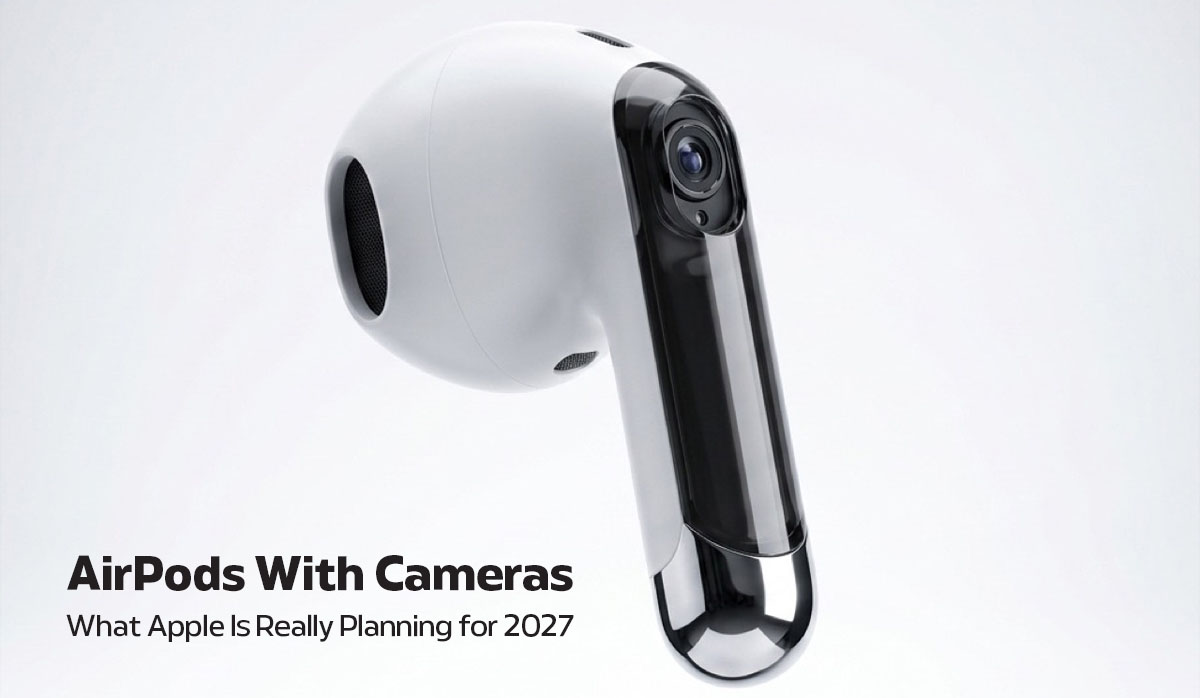
For a product line that has quietly become one of Apple’s biggest sellers, the AirPods have stayed remarkably simple. Put them in, they connect, you listen. But a steady drip of supply-chain leaks and Bloomberg reporting suggests that’s about to change in a big way, and not in the direction most people assume when they hear the words “AirPods with cameras.” If you’ve followed our earlier coverage of where Apple’s audio hardware is heading, including our AirPods Max 2 review, you’ll know the company has been laying groundwork for earbuds that do far more than play music.
Here’s the short version: the cameras are real, they’re coming, and they almost certainly won’t be taking any photos.
What the reports actually say
The most recent and most credible reporting comes from Bloomberg’s Mark Gurman, who says Apple is targeting a fall 2027 release for its first AirPods with cameras, marking the company’s first real move into AI wearable devices. That’s a shift from earlier expectations. Gurman previously suggested a late 2026 launch was possible, but believes Apple’s ongoing work on its overhauled Siri assistant forced a change of plans.
The idea itself isn’t new. Reliable Apple analyst Ming-Chi Kuo flagged camera-equipped AirPods back in mid-2024, pointing to infrared camera modules entering mass production around 2026. The two timelines aren’t really in conflict, since component production tends to run a year or more ahead of a finished consumer product, which is part of why so many outlets now converge on a 2027 launch window.
What makes this round of reporting feel solid is the specificity. Apple has reportedly developed a dedicated chip codenamed “Glennie” for the camera-equipped AirPods, and a separate chip codenamed “Nevis” for a future camera-equipped Apple Watch. When leaks start naming silicon, the project has usually moved well past the whiteboard stage.
These cameras won’t take photos
This is the part that trips people up, so it’s worth being blunt about it. The cameras in these AirPods are not there to snap pictures or record video. According to the reporting, the camera would function as an infrared sensor rather than a traditional lens, and the AirPods are expected to resemble the AirPods Pro 3 with the cameras embedded in the stem. There’s even a thoughtful privacy touch reportedly in the design: an included light would let people around the wearer know when the cameras are actively feeding data to Siri.
So what are they for? Vision, in the computer-vision sense. The goal, as Gurman frames it, is to give “eyes” and visual intelligence to Apple’s Siri assistant, letting users ask Siri questions about objects and the environment around them. Think of it as the Visual Intelligence feature already showing up on newer iPhones, except the sensor lives in your ear instead of needing you to pull a phone out and point it.
That distinction matters for anyone weighing whether this is a gimmick or a genuinely new category. It isn’t a camera in the way your iPhone has a camera. It’s a sensor that turns your surroundings into context that AI can act on.
How it would actually work day to day
The practical examples are where this starts to click. One scenario describes a user looking at ingredients on a kitchen counter and simply asking Siri what meal they could make. Because the AirPods can “see” roughly what you’re looking at, Siri has the visual context to give a useful answer without you describing anything. Apple is also reportedly exploring contextual reminders and navigation assistance that react to the wearer’s surroundings.
There’s a second, more ambitious layer that ties into Apple’s spatial computing ambitions. Kuo’s original reporting suggested the infrared cameras could enhance spatial audio when paired with Vision Pro, detecting which direction you turn your head and emphasising the sound coming from that part of the room. That’s the same set of ideas driving Apple’s push into mixed reality headsets, where audio, vision and AI are meant to blend into a single experience rather than living in separate devices. There’s even talk of the IR sensors enabling a form of in-air gesture control, letting you interact with hand movements.
Whether all of that ships at once is a different question. Apple has a long history of building hardware capable of more than the launch software exposes, then unlocking features over time.
Part of a much bigger AI wearables push
The camera AirPods aren’t a one-off experiment. They’re one piece of a wider strategy. Bloomberg’s reporting indicates Apple plans to embed tiny AI cameras across multiple devices, including AirPods and Apple Watch models, with smart glasses also expected around the same 2027 timeframe. You can read the fuller breakdown of that roadmap in MacRumors’ coverage of Apple’s plans for tiny AI cameras across its wearables.
The smart glasses are the headline-grabber here, positioned as Apple’s eventual answer to Meta’s Ray-Ban glasses, complete with cameras, microphones and on-device AI. The glasses chip is reportedly based on Apple Watch silicon, which suggests AI features will crossover between these devices rather than living in isolation. Apple is even said to be exploring an AI pendant with a built-in camera. The AirPods, in this reading, are the gentlest on-ramp, a device people already own and trust, quietly upgraded with sensing abilities.
And 2027 is shaping up to be a landmark year regardless. Alongside these wearables, AppleInsider notes the same window could bring a redesigned 20th-anniversary iPhone and a second-generation foldable, making this potentially Apple’s busiest product year yet.
Why 2027 and not sooner
The delay tells you something about Apple’s priorities. The reason the AirPods slipped from a possible 2026 launch to fall 2027 reportedly comes down to Siri, since Apple’s work on its new AI assistant reshaped the timeline. Camera AirPods are essentially useless without an assistant smart enough to interpret what they’re sensing, so it makes sense that the hardware waits on the software rather than the other way around. A pair of earbuds that can “see” but can’t understand would be a hard sell.
There’s also a healthy amount of hedging worth keeping in mind. Several outlets that track Apple closely have flagged that this kind of multi-year roadmap reporting comes with real uncertainty, and Apple has been known to shift or shelve products that have already reached internal testing.
What it means for buyers
If you’re in Australia and weighing an AirPods purchase right now, none of this should stop you. New pairs are easy to find at the likes of JB Hi-Fi, while refurbished options through Phonebot, Reebelo and Refurbed can shave a solid chunk off the price if you’d rather not pay full retail for hardware that a sensor-equipped generation will eventually replace. A 2027 launch is a long way off, the current AirPods Pro and AirPods Max remain excellent, and first-generation Apple hardware in a brand-new category rarely arrives cheap. For most people, the smarter play is to enjoy what’s available today and treat the camera AirPods as a glimpse of where the ecosystem is heading, not a reason to wait years.
What’s genuinely interesting is the shift in what AirPods are for. For a decade they’ve been about getting audio in. The next chapter is about getting context out, letting a small sensor in your ear help your phone, your watch and eventually your glasses understand the world around you. If Apple gets the privacy and the Siri experience right, 2027’s AirPods could end up being remembered less as earbuds with cameras and more as the moment Apple’s AI quietly moved off the screen and into the world.