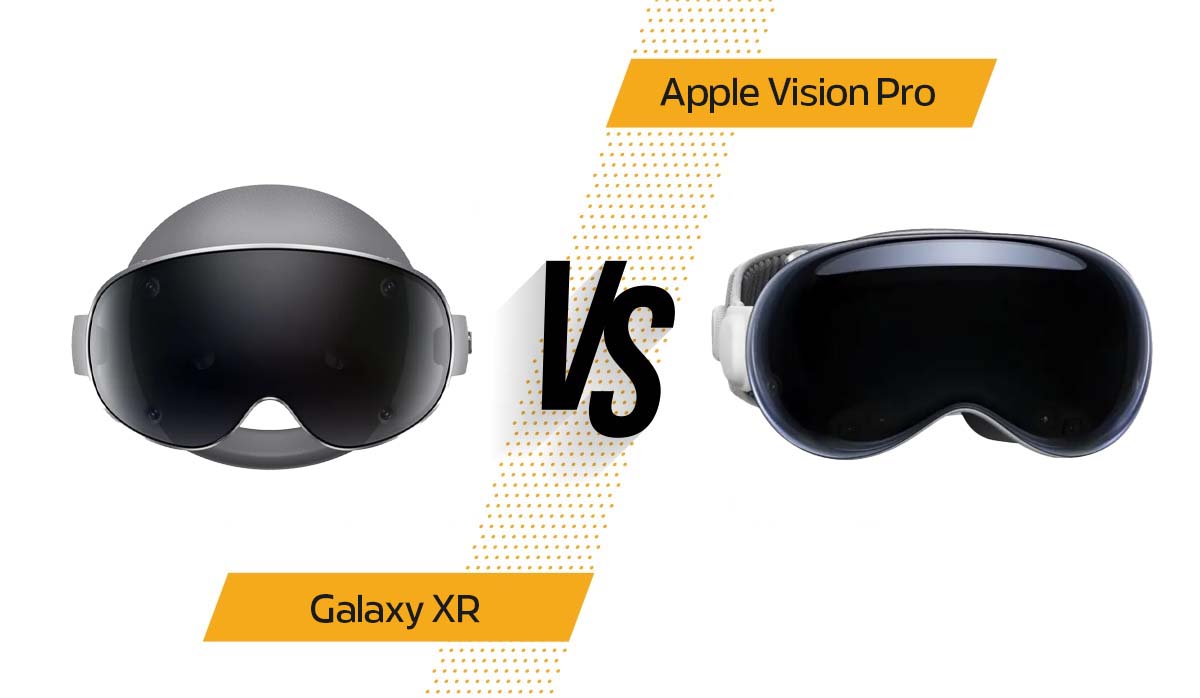
For nearly two years, Apple had the high-end headset category almost to itself. The Vision Pro was the only “spatial computer” anyone talked about, and at AU$5,999 it was also the one most people could never quite justify. That changed in October 2025, when Samsung, working with Google and Qualcomm, launched the Galaxy XR at roughly half the price. Suddenly there’s a genuine rival, and the Galaxy XR vs Apple Vision Pro debate has become the most interesting matchup in mixed reality right now.
The timing was almost poetic. Apple slipped its faster M5 chip into the Vision Pro in October 2025, while Samsung’s Galaxy XR arrived the very same month as an all-new product. So this isn’t an old headset against a new one. Instead, it’s two freshly updated flagships going head to head. Here’s how they stack up across price, design, displays, performance, software and real-world value.
The quick verdict
If you want the short answer: the Galaxy XR is the smarter buy for most people. It delivers a strikingly similar experience, with floating app windows, sharp passthrough video, and hand and eye control, for close to half the money, and Google’s Gemini gives it a genuinely useful AI layer. The Apple Vision Pro still wins on display polish, build quality and tight ecosystem integration, but you pay a heavy premium for that extra refinement.
Now the detail.
Price: a gap that’s impossible to ignore
This is where the comparison really begins. The Samsung Galaxy XR launched at US$1,799, while the Apple Vision Pro starts at US$3,499, close to double. For Australian readers the gulf is even starker: the Vision Pro has sold locally for AU$5,999 since July 2024, while the Galaxy XR isn’t officially on sale in Australia at all yet, having launched only in the US and South Korea. Importing one lands at roughly AU$3,400 to AU$3,700 once shipping and GST are added, which still comes in well under the Vision Pro’s local sticker.
Samsung also sweetened early sales with a content bundle, including Google AI Pro, YouTube Premium and more, that it valued at over US$1,000. The takeaway is simple: even after import costs, the Galaxy XR undercuts the Vision Pro by a wide margin.
Design and comfort
Physically, the two take very different approaches. The Galaxy XR weighs 545g with a separate 302g battery pack and uses a rigid “halo” strap that rests on your forehead, leaving your cheeks and peripheral vision open unless you clip in the included magnetic light blockers. The Apple Vision Pro feels more luxurious, with aluminium and glass plus the signature EyeSight front display that shows a rendering of your eyes, but the M5 model is heavier at around 750 to 800g, and that weight is noticeable during long sessions even with Apple’s newer Dual Knit Band.
Audio is strong on both. Each uses open speakers built into the strap for convincing spatial sound, though if you want true isolation you’ll still reach for a dedicated pair of headphones. Both headsets also tether to an external battery good for roughly two to two-and-a-half hours, so neither is built for marathon untethered use.
Displays and visuals
Apple holds a narrow lead here. Both headsets use dual micro-OLED panels with eye-popping resolution, but the Vision Pro’s M5 refresh pushes to a 120Hz refresh rate and renders about 10% more pixels than the original, while the Galaxy XR tops out at 90Hz. The Samsung panels are no slouch, at 3,552×3,840 per eye versus roughly 3,660×3,200 on the Vision Pro, and in everyday use both are razor-sharp. Side by side, most people would struggle to call a clear winner unless they were hunting for the difference.
Performance and chips
Different silicon, different strengths. The Galaxy XR runs Qualcomm’s Snapdragon XR2+ Gen 2, a chipset purpose-built for headsets, paired with 16GB of RAM. The Vision Pro instead uses Apple’s M5, the same class of chip you’d find in a MacBook, alongside a dedicated R1 processor that handles sensor and tracking data with very low latency. On paper Apple’s setup is the more powerful, and it shows in demanding spatial tasks; Samsung’s is more than fast enough for app windows, video and games, and the Gemini-driven experience leans on the cloud anyway.
Software and ecosystem: the real dividing line
This is the most important section, because it’s where the two headsets genuinely diverge. The Galaxy XR runs Android XR, the first headset version of Android, with Gemini baked in as a conversational assistant that can see what you’re looking at and act on it. Because it’s Android underneath, you get access to a huge library of existing mobile apps as well as XR-native ones, and it slots neatly alongside a Galaxy phone or any Android device.
The Apple Vision Pro runs visionOS 26, built on iPadOS, and its trump card is integration. If you already own an iPhone, iPad and Mac, the Vision Pro behaves like a natural extension of all of them. You can wirelessly turn it into a giant virtual display for your Mac, hand off content from your iPhone, and sign in with the same apps and accounts you already use. If you’re the kind of shopper already researching the best iPhone to buy in Australia, you’re exactly who that ecosystem lock-in is built to win over.
So the software question is really an ecosystem question: open Android and Google services, or Apple’s tightly controlled but seamless walled garden.
Specs at a glance
| Feature | Samsung Galaxy XR | Apple Vision Pro (M5) |
| Starting price | US$1,799 (≈AU$2,800) | US$3,499 / AU$5,999 |
| Released | October 2025 | M5 refresh, October 2025 |
| Operating system | Android XR (Gemini) | visionOS 26 |
| Chip | Snapdragon XR2+ Gen 2 | Apple M5 + R1 |
| RAM | 16GB | 16GB unified |
| Storage | 256GB | 256GB / 512GB / 1TB |
| Display | Dual micro-OLED, 3,552×3,840 per eye, up to 90Hz | Dual micro-OLED, ~3,660×3,200 per eye, up to 120Hz |
| Weight | 545g + 302g battery | ~750 to 800g + 353g battery |
| Tracking | Eye, hand, face (controllers optional, US$250) | Eye, hand, voice |
| Connectivity | Wi-Fi 7, Bluetooth 5.4 | Wi-Fi 6, Bluetooth 5.3 |
| Battery life | About 2 to 2.5 hours | About 2.5 hours |
The value angle: should you buy new at all?
Here’s the part most comparisons skip. Both of these are early-generation products in a category that’s still moving fast, which makes spending AU$4,000 to AU$6,000 on the absolute newest model a tough sell, and even glowing first impressions have cooled into more measured takes, with AppleInsider calling the M5 Vision Pro a flawed wonder after living with it for three months.
That’s exactly why the refurbished market is worth a look, and why it pays to understand the difference between refurbished and used Apple gear before you buy. While the Vision Pro sells brand-new through major Australian retailers like JB Hi-Fi, shoppers chasing the same Apple experience without the full new-price premium can often find the headset and other Apple kit refurbished through specialists like Phonebot, which can take a meaningful slice off the cost. If you’re going to drop serious money on a headset that may be superseded within a year, buying certified refurbished is simply smarter shopping.
Who should buy which?
Buy the Samsung Galaxy XR if you want the best value, you live in the Android and Google ecosystem, or you’re drawn to Gemini-powered AI in a lighter, more comfortable fit.
Buy the Apple Vision Pro if you already own Apple devices, you want the sharpest display and most premium build, and the price isn’t a dealbreaker.
For most buyers in 2026, the Galaxy XR strikes the better balance of price and capability. But the Vision Pro remains the headset to beat on sheer polish, and a refurbished one narrows the value gap considerably.
Frequently asked questions
Is the Galaxy XR available in Australia? Not officially yet. At launch it was sold only in the US and South Korea, so Australians currently need to import one.
Is the Galaxy XR better than the Apple Vision Pro? It’s far better value and very close on the core experience, but the Vision Pro edges it on display refresh rate, build quality and Apple ecosystem integration.
Do they run the same apps? No. The Galaxy XR uses Android XR, which runs Android and XR apps plus Gemini, while the Vision Pro uses visionOS, which runs iPad and visionOS apps tied to Apple services.