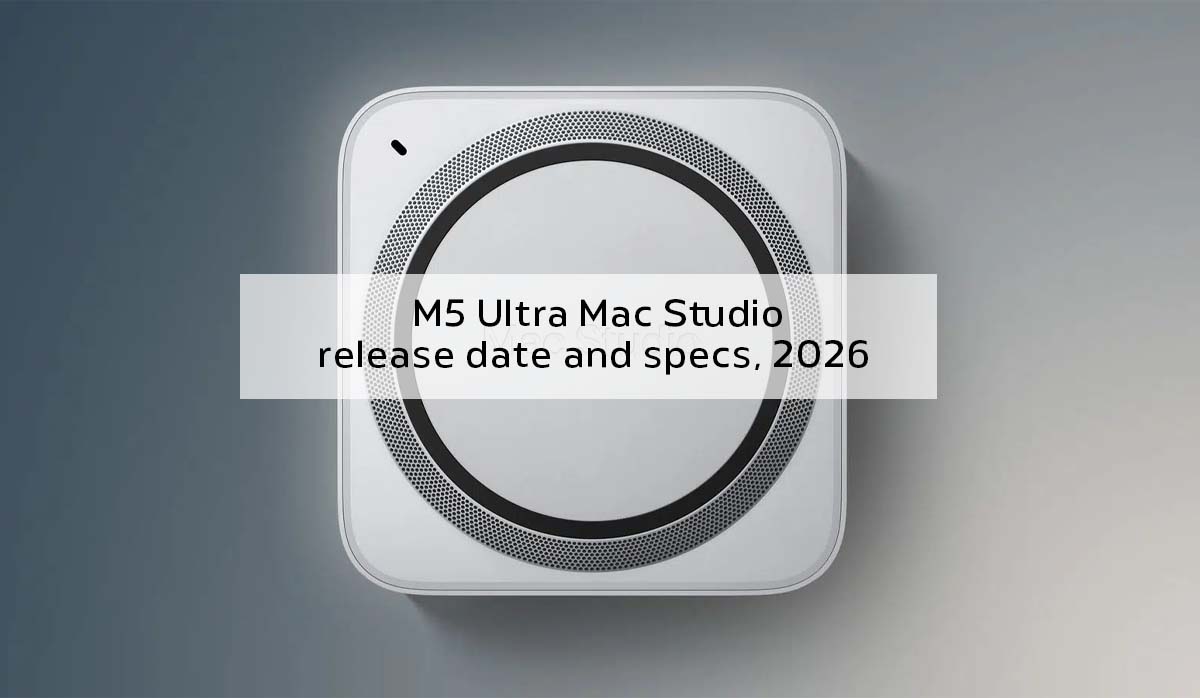
The Mac Studio has been sitting untouched since March 2025, an unusually long stretch for a machine that sells itself on raw horsepower. That drought looks set to end before the year is out. Apple is preparing an M5 Ultra refresh, and according to Bloomberg’s Mark Gurman, it should land in the back half of 2026.
What makes this one interesting isn’t the silicon. It’s the memory. Apple has been testing the new Mac Studio with configurations reaching 768GB of unified memory, at precisely the moment a global DRAM shortage is forcing the company to strip high-capacity options out of its existing lineup. That tension, between a machine designed around enormous memory pools and a market where memory is the scarcest commodity in tech, is the real story of the M5 Ultra Mac Studio.
Here’s what the reporting supports, what it doesn’t, and what it means if you’re weighing a purchase from Australia.
When is the M5 Ultra Mac Studio coming out?
The short version: late 2026, most likely around October, though Apple hasn’t confirmed anything.
The timeline has slipped more than once. Gurman initially reported Apple was targeting the first half of 2026, which made a WWDC unveiling look plausible. That window came and went. By April, Bloomberg was pointing to roughly October, and in his late-June Power On newsletter Gurman reaffirmed the M5 Ultra is still on track for this year, with a more substantial M7 Ultra follow-up not expected until 2028.
The delay wasn’t a design problem. It was supply. Memory chip shortages and the associated cost increases pushed the refresh back, and there’s a quiet signal in the current lineup worth noticing: the M3 Ultra Mac Studio already carries delivery estimates stretching into October. Apple isn’t exactly rushing to clear the shelves.
One curiosity from Gurman’s latest report: he mentions the Ultra and only the Ultra. Back in March he referred to Mac Studio models in the plural, implying an M5 Max variant alongside it. The omission may be nothing more than an editing decision. But it’s a loose thread, and worth watching.
M5 Ultra specs: what to expect
Ultra chips are built by fusing two Max dies together. That has been Apple’s approach since the M1 Ultra, and it explains why the M4 generation skipped an Ultra entirely. The M4 Max simply lacked the UltraFusion interconnect required to pair.
On current reporting, the M5 Ultra is expected to deliver:
- Around 36 CPU cores, up from the M3 Ultra’s 32
- Around 80 GPU cores, matching the M3 Ultra’s ceiling
- Substantially higher memory bandwidth, reportedly north of 1,000GB/s
- Up to 768GB of unified memory, if supply allows
Read those numbers carefully, because the headline is misleading. On core count alone, the M5 Ultra is barely a leap over the M3 Ultra. Four extra CPU cores and identical GPU core count is not the generational jump the name suggests.
The gains live elsewhere. The M5 architecture introduces per-core neural acceleration in the GPU and significantly improved matrix math, which handles the operations that dominate machine learning inference. For anyone running large local models, that matters far more than core count. Combine it with a wider memory bus and the M5 Ultra becomes a meaningfully different machine to the M3 Ultra, even if the spec sheet doesn’t scream it.
Macworld has also reported that the M5 Max moves to a revised “Fusion Architecture” on an advanced 3nm process, allowing multiple dies to behave as a single SoC, a change intended to make Ultra-class chips easier to scale in future generations.
Externally, don’t get your hopes up. Gurman says the internal changes amount to an improved heatsink for better sustained thermal performance under load. No redesign. If you want a sense of how Apple positions its Ultra-tier silicon across the range, our breakdown of the six major features defining Apple’s Ultra-class hardware covers the wider picture.
The 768GB question
This is where scepticism is warranted.
Apple has tested 768GB of unified memory. Testing is not shipping. And the surrounding evidence points the other way: Apple sold the M3 Ultra Mac Studio with up to 512GB of RAM, then quietly removed that configuration in March 2026. The 256GB option went in May. Today, the M3 Ultra Mac Studio tops out at 96GB.
Think about that. Apple pulled its high-memory configurations because it couldn’t source the parts. Asking it to simultaneously launch a 768GB machine, eight times the current ceiling, during the worst memory shortage in decades requires a certain optimism.
Industry analysts at TrendForce reported DRAM prices rose by as much as 98 per cent in Q1 2026, with a further 58 to 63 per cent forecast for the following quarter. The AI data-centre buildout is consuming memory faster than manufacturers can produce it, and Samsung and SK Hynix are prioritising those orders. Observers have taken to calling it “RAMageddon,” which is glib but not inaccurate.
If a 768GB Mac Studio does ship, expect it as a build-to-order option with a price attached that most readers of this article will never seriously consider.
Pricing: the Australian reality
Apple raised Mac and iPad prices across Australia in June 2026, and the Mac Studio absorbed one of the heaviest blows in the lineup.
The Mac Studio’s Australian starting price climbed from $3,499 to $4,299, an $800 jump of roughly 23 per cent. For context on the rest of the range: the iMac went from $1,999 to $2,399, the MacBook Pro M5 from $2,699 to $3,199, and the MacBook Air M5 from $1,799 to $2,099.
In the US, the M3 Ultra configuration now starts at $5,299, up $1,300, and that’s for a machine capped at 96GB of RAM.
An Apple spokesperson told Australian outlets the company had been shielding customers from component costs but had reached a point where price rises were unavoidable, describing the increase as something they had never seen move this quickly. Tim Cook has separately likened the memory situation to a hundred-year flood.
Extrapolate that to an M5 Ultra with a heavily expanded memory ceiling and the arithmetic gets uncomfortable. Estimates circulating put a base M5 Ultra around US$4,700, though that figure deserves scrutiny: it would sit below the M3 Ultra’s current US$5,299, and a price cut is hard to imagine when memory is the constraint. A maxed configuration could clear US$10,000. Australian pricing, historically, does not soften that.
Should you buy now or wait?
If you’re shopping today, the case for waiting is strong, and it’s not a close call.
The current Mac Studio is fifteen months old, sits at the end of its product cycle, has just absorbed a 23 per cent price increase locally, and has had its most compelling memory configurations withdrawn. You would be paying more for less, months before a replacement. MacRumors’ own buyer’s guide currently advises against purchasing.
The counter-argument is that the memory crisis shows no sign of resolving, and the M5 Ultra may launch at a higher price than today’s machine. Waiting doesn’t guarantee a better deal. It guarantees a better machine.
There’s a third path worth considering, particularly for studios and freelancers in Australia running production workloads on a fixed budget. The M2 Ultra and M3 Ultra Mac Studios remain formidable machines. The shortfall against the M5 Ultra will be felt mainly in ML inference, not in video editing, 3D rendering or audio work. Buying one of those refurbished rather than new sidesteps the price increase entirely.
Refurbished Apple hardware in Australia has matured considerably as a category, with sellers like GreenGadgets, Phonebot and OzMobiles offering graded, warranty-backed Macs and iPhones at meaningful discounts to retail. The distinction between refurbished and merely used stock matters enormously here, and we’ve covered what to check before buying in a separate guide. In a market where new hardware has jumped 23 per cent in a single announcement, that distinction is worth understanding properly.
The bottom line
Apple will almost certainly ship an M5 Ultra Mac Studio in 2026, probably around October, and probably without a redesign. Core counts will rise modestly. AI performance will rise sharply. Memory will be the constraint that defines the entire product: how much Apple can offer, and what it charges for it.
For most buyers, the honest advice is to hold. Not because the M5 Ultra will be cheap, but because paying an inflated price for end-of-cycle hardware is the worst of both worlds.