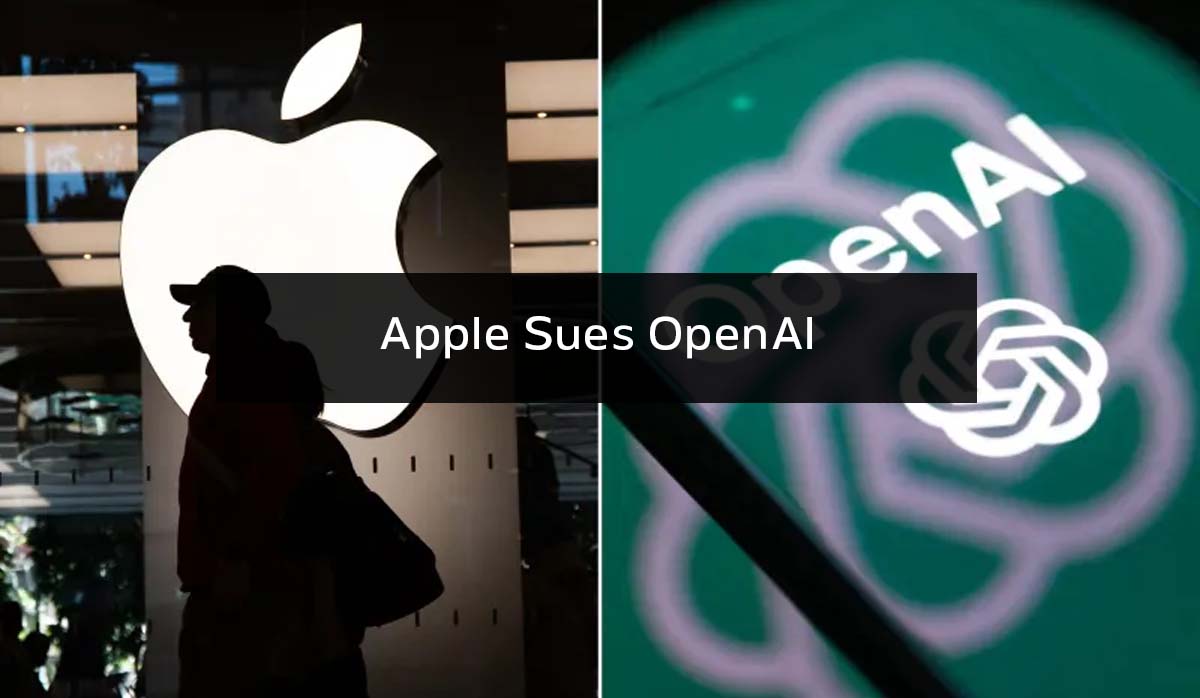
Apple rarely sues, and it almost never sues loudly. So when the company filed against OpenAI on Friday, July 10, in the U.S. District Court for the Northern District of California, the filing itself mattered less than the language inside it.
Apple accuses OpenAI of trade secret theft and breach of contract. It claims the theft was not the work of two rogue engineers. It says the theft was a pattern, directed from the top, carried out by former Apple staff who took confidential material with them. And it says all of it served one purpose: the hardware product OpenAI is quietly building.
Here is what the complaint says, and why it matters.
What Apple is claiming
The lawsuit centres on two former Apple employees who now work at OpenAI.
The first is Tang Tan, OpenAI’s Chief Hardware Officer. Tan is not a minor figure. He spent 24 years at Apple, most recently as vice president of product design for the iPhone and Apple Watch. He was the person responsible for how Apple’s two biggest products physically came together.
Apple alleges that Tan used internal Apple project code names during OpenAI’s recruiting process. It claims he asked job candidates, who were Apple employees at the time, to bring Apple hardware components to their interviews. It says he coached departing staff on how to get around Apple’s security procedures, and that he pushed candidates for details about unannounced products.
If those claims hold up, this was not a grey area. It was a recruiting pipeline run as an intelligence operation.
The second name is Chang Liu, a senior systems electrical engineer with eight years at Apple. He left for OpenAI in 2026. Apple says Liu never returned his Apple laptop, and used it to download confidential technical documents. Those files allegedly covered unreleased technologies, engineering presentations, and proprietary project data. Apple also claims Liu shared that material with colleagues who were interviewing at OpenAI, in one case telling a coworker what to study beforehand.
Then comes the detail that shifts this from bad behaviour to company benefit. Apple says OpenAI and its partners have already used the stolen information in hardware development. The filing points to a proprietary metal finishing technique that OpenAI allegedly used after misleading a supplier into thinking it had Apple’s blessing.
Apple also says it wrote to OpenAI in February. It got no reply. Five months later, it sued.
The line Apple wanted you to read
Legal filings are usually dull. This one is not.
“This is the tip of the iceberg. Apple lacks visibility into what’s been happening behind closed doors at OpenAI, where such misconduct is normalized and exemplified by leadership. As a natural result, OpenAI’s nascent hardware business now rests on the shakiest of foundations, rotten to its core by its illegal reliance on misappropriated trade secrets.”
Rotten to its core. Apple’s lawyers wrote that on purpose. Apple’s lawyers do not make accidental fruit puns. That sentence was built to be screenshotted, and it tells you the company is treating this as a public statement, not a routine cleanup.
The official comment was calmer. Apple said “significant evidence has emerged” that OpenAI staff wrongfully took confidential information about unreleased products, and that it will “always defend our teams’ hard work.” OpenAI had not commented when the court filing went public.
Why this is really about a phone
Strip away the laptop and the metal finish, and the subtext is obvious.
OpenAI is building hardware. It bought io, the device startup founded by former Apple design chief Jony Ive, for $6.5 billion in 2025. In April 2026, analyst Ming-Chi Kuo said the resulting device could be a smartphone built around AI agents instead of apps.
Think about what that means. A phone designed by the man who designed the iPhone, engineered by the man who ran iPhone product design, sold under the most recognisable AI brand on earth. That is not a rival built from scratch. It is a rival built largely from Apple’s own parts.
Note who is named and who is not. io appears in the filing. Jony Ive does not. Apple went after the company and the operational leadership, and left its former design chief alone. Read that how you like.
Seen this way, the lawsuit looks less like a grievance and more like positioning. Apple wants it on the record, early, that whatever OpenAI ships was built on tainted ground. That claim will now follow every OpenAI hardware announcement. Meanwhile Apple’s own roadmap keeps moving, and the iPhone 18 leaks suggest it has no plans to slow down.
What Apple actually wants
The remedies are narrower than the rhetoric. Apple wants the court to stop OpenAI using or disclosing its trade secrets, to force the return of confidential material, and to preserve evidence.
That last request is the tell. Apple normally investigates leaks internally, by reading server logs and company device data. That method stops at the firewall. Once a lawsuit is filed, discovery starts, and Apple gains the right to look inside OpenAI: internal messages, recruiting notes, supplier emails, hardware documents.
So Apple is not only suing. It is buying a window into OpenAI’s hardware programme at its most fragile moment, and the fight over trade secrets will largely be decided there.
What happens next
Three things to watch.
OpenAI’s answer. Five months of silence on Apple’s letter looks bad. OpenAI has to say something real.
A possible delay. If the device depends on processes Apple claims as its own, engineering may need reworking. That costs months, and a slip would be the loudest proof that the lawsuit has teeth.
The talent chill. Apple’s real problem is not one laptop. It is that AI firms with huge funding can hire away its senior hardware people. A public lawsuit sends a message to every Apple engineer with a full LinkedIn inbox.
For years the question was whether anyone could build a real alternative to the iPhone. Apple’s lawyers have now told us who it thinks is trying.
These are allegations that have not been tested in court. We will update as OpenAI responds.