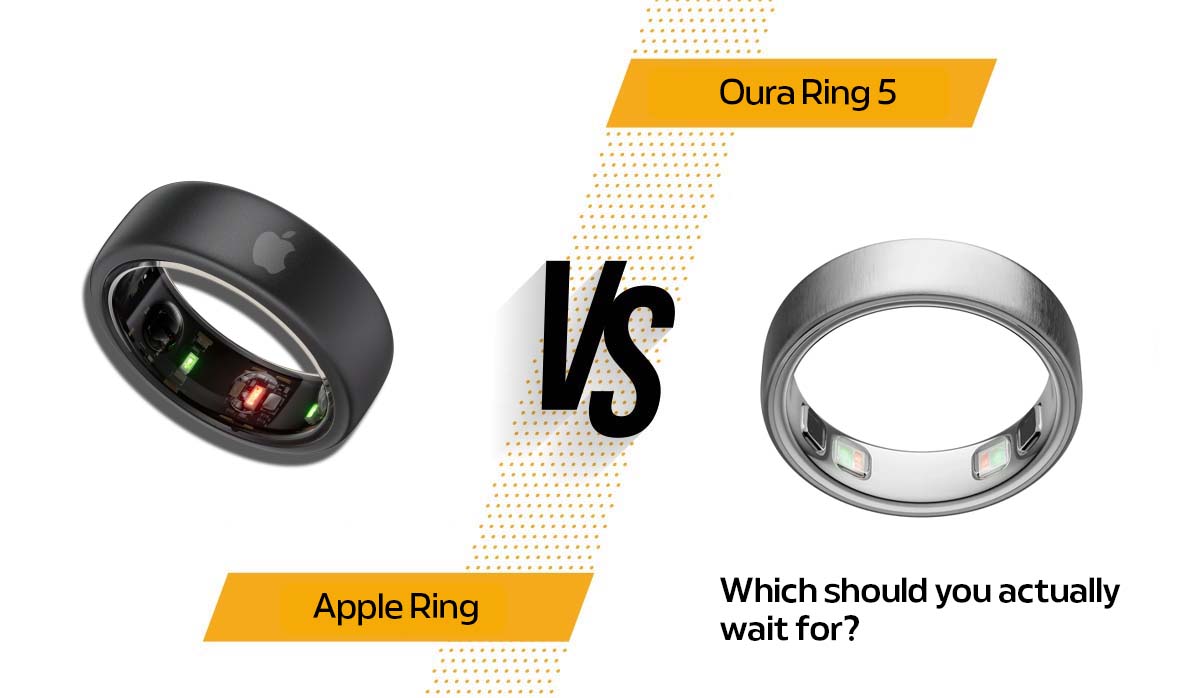
The smart ring decision just got more complicated. Only days ago, rumours of an Apple Ring resurfaced yet again, this time reignited by the arrival of the Oura Ring 5, the slimmest health ring yet and one that early hands-on reviews rate as the best on the market. For Australians eyeing their first fitness-tracking ring, that creates a genuine dilemma. Do you buy the Oura Ring 5 that’s in stock right now, or hold out for a mystery Apple wearable that may not even exist yet?
Here’s an honest, no-hype breakdown of how the two compare on price, features and timing, and who should actually wait.
The state of play: one ring is real, the other isn’t
Before anything else, be clear on this: the Oura Ring 5 is a product you can order today. The Apple Ring is a rumour, a well-supported one, backed by years of patents and steady Apple Ring rumours, but a rumour all the same. Apple has never confirmed it. There’s no release date, no price and no official spec sheet.
The talk flared up again at the end of June 2026, largely because the Oura Ring 5 has raised the bar so dramatically that speculation about Apple entering the category feels inevitable. Interestingly, Oura’s own CEO has previously argued that Apple is unlikely to build a ring at all, because it risks cannibalising Apple Watch sales, and because, in his words, the category is genuinely hard to get right.
So this isn’t a like-for-like comparison. It’s a “bird in the hand” question.
Oura Ring 5: what you can actually buy today
The Oura Ring 5 landed in mid-2026 and immediately became the benchmark. Oura calls it the world’s smallest smart ring, and the numbers back it up. It’s roughly 40% smaller than the Ring 4, measuring about 6mm wide and just over 2mm thick, and it weighs around 2 grams. In plain terms, it now looks close enough to a normal band that most people won’t clock it as tech on your finger.
Pricing starts at US$399 for the Silver and Black finishes, rising to US$499 for the premium colours (Gold, Stealth, Brushed Silver and Deep Rose). For Australian buyers, that converts to roughly AU$600 once local pricing and GST are factored in, so check Oura’s Australian store for the exact figure before you commit.
There’s a catch worth flagging loudly: the ongoing membership. To unlock the ring’s full feature set, you’ll pay around US$5.99 a month or US$69.99 a year. That subscription, not the ring itself, is the real long-term cost, and it’s the single biggest gripe reviewers keep raising.
What you get for it is legitimately strong:
- Sleep, readiness and activity scores refined over multiple generations
- Six-to-nine-day battery life on a single charge
- New-for-2026 blood pressure signals and nighttime breathing analysis
- More accurate sensors and a tougher, scratch-resistant coating
- Live activity tracking and expanded women’s health features
The consensus from reviewers who’ve lived with it is that Oura solved comfort more than it added headline features, but for most buyers, comfort is exactly what was missing.
Apple Ring: what the rumours actually promise
Here’s where you need patience and a pinch of salt. Everything about the Apple Ring comes from patents and supply-chain whispers rather than Apple itself.
Based on filings spotted over the past couple of years, an Apple Ring would likely be pitched as a screen-free alternative to the Apple Watch, a discreet way to tap into Apple Health for sleep, steps, heart rate and temperature without strapping on a watch. But the patents hint at more ambitious tricks, too. There’s talk of gesture control (tapping two fingers together to trigger an action), an onboard microphone that could summon Siri, and even the ability to control smart-home devices like lights or your Apple TV.
The most intriguing rumour ties the ring to Apple’s headset ambitions. Several patents suggest it could act as a companion controller for the Vision Pro, improving hand-tracking accuracy and delivering the haptic feedback Apple already builds into its other devices. If you’ve followed the Vision Pro comparison, a ring that sharpens spatial input starts to make a lot of strategic sense for Apple.
The point stands, though: none of this is confirmed, and a companion controller is a very different pitch to a standalone health tracker.
Apple Ring vs Oura Ring 5 at a glance
Here’s the quick head-to-head for anyone skimming:
- Availability: Oura Ring 5 is on sale now. Apple Ring is unconfirmed with no release date.
- Price (est.): Oura from ~AU$600 plus subscription. Apple Ring rumoured to slot between the Apple Watch SE and Series-tier pricing, realistically an AU$450 to AU$750 range if it ever ships.
- Subscription: Oura requires a paid membership for full features. Apple’s ecosystem typically bundles health features free, a potential Apple advantage.
- Health tracking: Oura is proven and mature. Apple would arrive as a first-generation product.
- Ecosystem: Oura works across iOS and Android. An Apple Ring would almost certainly favour iPhone owners.
- Extra tricks: Apple Ring is rumoured to add gesture control, Siri and Vision Pro integration. Oura stays focused purely on health.
- Battery: Oura delivers six to nine days. Apple Ring battery life is pure speculation.
The price question everyone’s Googling
Search interest around “Apple Ring price” is spiking precisely because there’s no answer yet, and that uncertainty is the whole problem. The most credible estimates place it somewhere between the Apple Watch SE and the flagship Apple Watch, which lands it in that AU$450 to AU$750 window.
Crucially, Apple may skip Oura’s subscription model entirely. Apple Health features generally come free with your device, so even a slightly pricier Apple Ring could work out cheaper over three years than an Oura plus its recurring membership. That’s a real consideration if you’re the type to keep a wearable for years.
So, should you wait?
It comes down to who you are.
Buy the Oura Ring 5 now if: you want the best smart ring that exists today, you’re comfortable paying a subscription, and you don’t want to gamble on an Apple product that might launch in 2027, 2028 or never. It’s mature, comfortable and genuinely excellent.
Wait for the Apple Ring if: you’re deep in the Apple ecosystem, you’d rather avoid a monthly fee, and you’re happy to keep using your Apple Watch or phone for health tracking in the meantime. Patience could be rewarded, but there’s no guarantee it’ll pay off.
If you land in the “wait” camp but still want in on Apple’s health tools sooner, a smart middle path is picking up a refurbished Apple Watch rather than buying new. Australian refurbishers like Greengadgets, Reebelo and Phonebot stock discounted, quality-checked Apple wearables, which lets you close your rings today without over-committing before the Apple Ring’s status is clear. Just make sure you understand refurbished versus used before you buy, so you know exactly what condition and warranty you’re getting.
The bottom line
Right now, this isn’t really a fair fight. The Oura Ring 5 is a finished, class-leading product, and the Apple Ring is a promising idea with no confirmed existence. If you need a smart ring in 2026, Oura is the obvious answer. If you can wait, and you value the Apple ecosystem over everything else, holding out is defensible. Just don’t hold your breath for a firm launch date.
Either way, the smart ring era has clearly arrived. The only question is whose logo ends up on your finger.