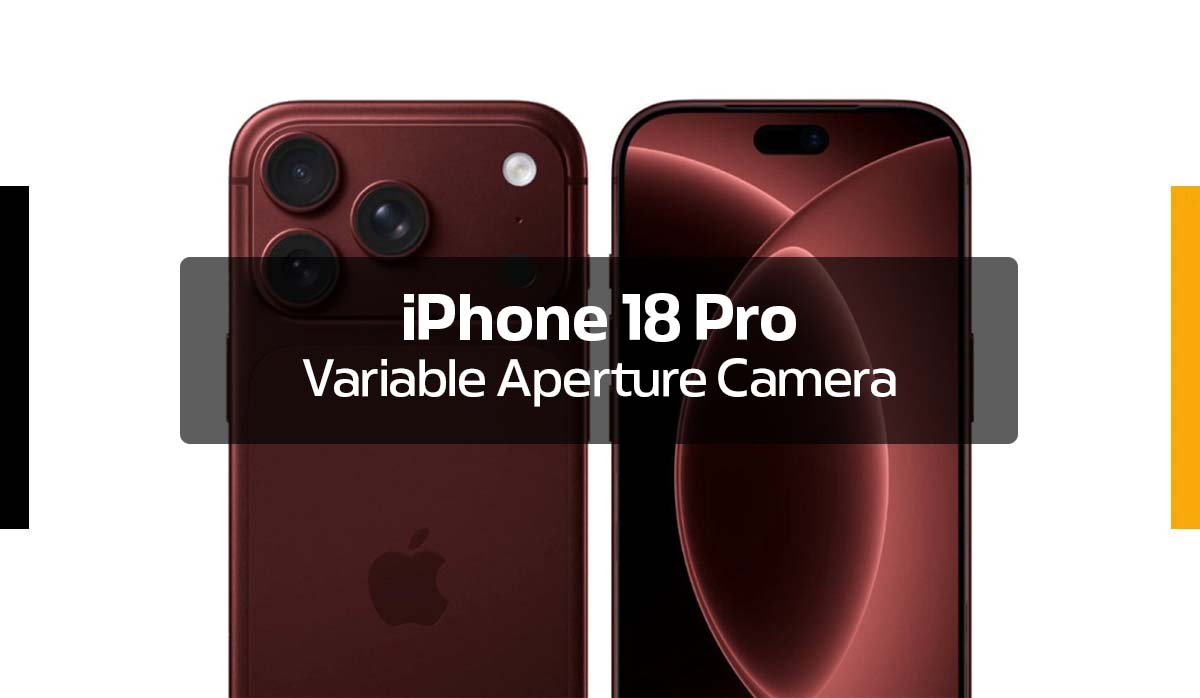
Apple’s most ambitious iPhone camera upgrade in years has cleared another major hurdle. According to a new supply chain report, the first hardware components for the iPhone 18 Pro variable aperture system are already rolling off the production line, moving one of 2026’s most talked-about rumors firmly out of the speculation column and into the realm of confirmed engineering.
Korean outlet ETNews reports that Chinese optics manufacturer Sunny Optical has begun building the actuator for the new system, the tiny mechanical component responsible for physically moving the aperture blades that control how much light hits the sensor. Luxshare ICT is reportedly lined up as a secondary supplier for the same part, a standard Apple tactic to hedge against bottlenecks when a component is this mechanically delicate and this central to the phone’s identity.
Final module assembly will fall to LG Innotek, the same partner Apple trusted with the tetraprism periscope system that debuted on the iPhone 15 Pro Max. LG Innotek is already installing dedicated equipment at its Gumi facility in South Korea, with full camera module production expected to begin in June or July. That timeline tracks almost exactly with a September 2026 launch window, since camera modules typically enter mass production two to three months before a new iPhone ships.
Why Variable Aperture Is a Big Deal for iPhone
If you’ve been using an iPhone Pro for the last four years, you’ve been shooting every photo at exactly one aperture: f/1.78. Every model from the iPhone 14 Pro through the iPhone 17 Pro uses the same fixed opening, meaning the lens is wide open, all the time, in every scene.
That’s fine for a lot of situations. A wide aperture gathers light, which is why iPhone Night mode shots have improved so dramatically in recent years. But it comes with tradeoffs. In bright outdoor light, that fixed f/1.78 forces the camera to compensate with very fast shutter speeds, and you lose some control over depth of field. You also lose the option to stop down the lens for landscapes, product shots, or any scene where you want more of the frame in focus by default.
A variable aperture fixes that. Analyst Ming-Chi Kuo, who first flagged the feature back in late 2024, said the iPhone 18 Pro’s wide-camera lens would be upgraded to a variable aperture system for the first time in iPhone history. Instead of a static opening, the new system uses mechanical blades that can physically resize to let in more or less light depending on the scene. In dim environments, the aperture widens to pull in every available photon. In bright conditions, it narrows to prevent overexposure and sharpen depth of field across the frame. It also means iPhone will finally produce true optical bokeh, with background blur coming from actual glass and physics rather than from a machine-learning model guessing where a subject ends and the background begins.
Interestingly, there’s reason to believe Apple is using shape memory alloy nitinol rather than a conventional micro-motor to drive the blades, a choice consistent with how the company has historically handled image stabilization and autofocus components. Nitinol deforms when an electrical current is applied and returns to its original shape when it cools, offering very precise control in a vanishingly small footprint, exactly what Apple needs given how tight the real estate is inside the iPhone 18 Pro’s redesigned camera plateau.
Apple Is Not First, But That’s Not the Point
Variable aperture on a smartphone isn’t new. Samsung actually beat Apple to it by eight years with the Galaxy S9 in 2018, which offered a two-step f/1.5 to f/2.4 aperture, followed by the Galaxy S10 the following year. Samsung then quietly dropped the feature from the Galaxy S20 onward, citing added thickness and cost.
Chinese manufacturers have carried the torch in the meantime. The Xiaomi 14 Ultra shipped with a stepless variable aperture ranging from f/1.63 all the way to f/4.0, and both HUAWEI and HONOR have shipped similar systems in their flagship lines. What Apple is expected to bring to the table isn’t the technology itself but its usual combination of tight hardware-software integration and scale, a variable aperture that works seamlessly with Photographic Styles, Smart HDR, and the next generation of Portrait mode.
The irony isn’t lost on anyone watching the space. Samsung has reportedly asked its camera module partners to revisit variable aperture in response to Apple’s plans, with a possible return on the Galaxy S27 Ultra in 2027. A feature Samsung pioneered and then abandoned may be dragged back onto Android flagships specifically because Apple is finally adopting it.
What It Means for Current iPhone Owners
For anyone currently holding an iPhone 15 Pro, 16 Pro, or even a 17 Pro, the variable aperture rumor poses an interesting question: upgrade to the iPhone 18 Pro this September, or ride out another year on hardware that still takes excellent photos? If you’re on the fence, it’s worth asking whether the iPhone 17 already does enough for your needs before committing another $1,500-plus to next year’s model.
For Australian buyers in particular, the calculus matters. The iPhone 17 Pro is still one of the best smartphone cameras ever made, and a September launch for the 18 Pro means a predictable wave of trade-ins will flood the refurbished market from late 2026 onward. If you’re not chasing the latest aperture trick, picking up a certified refurbished iPhone 17 Pro or 16 Pro from a trusted local retailer like Phonebot often lands you 90% of the camera experience at a fraction of the outright price, with warranty and grading standards that take most of the anxiety out of buying secondhand.
That’s a real buying decision a lot of people will face. Variable aperture is genuinely useful, but it’s not a feature most casual shooters will miss on a 17 Pro if their current phone was bought within the last couple of years.
The iPhone 18 Pro Is Shaping Up to Be a Significant Upgrade
Variable aperture is the headline, but it won’t be the only story. The latest round of iPhone 18 Pro leaks point to a next-generation A20 chip built on TSMC’s 2-nanometer process for meaningful efficiency gains, more power-efficient LTPO+ displays, a smaller Dynamic Island, and a simplified Camera Control button that addresses some of the complaints users have raised since the feature debuted on the iPhone 16 line.
Combined, those upgrades would make the iPhone 18 Pro one of the most substantive Pro releases since the move to titanium on the iPhone 15 Pro. The camera, in particular, looks like a genuine generational leap rather than an iterative refinement, and it’s the first time in a long while that Apple is introducing hardware Samsung doesn’t already have a clear answer to.
What Happens Next
With actuator production already underway at Sunny Optical and module assembly scheduled to ramp at LG Innotek within weeks, the iPhone 18 Pro variable aperture system is effectively locked in for the September 2026 lineup. Barring a last-minute yield problem, Apple fans should expect the iPhone 18 Pro and iPhone 18 Pro Max to launch on schedule with one of the most interesting new camera features the lineup has seen in years.
The bigger question isn’t whether the hardware will ship. It’s how Apple chooses to expose it. Will users get manual control over the aperture value, as they do with professional mirrorless cameras? Or will Apple keep things automatic, letting the scene dictate the opening and treating the feature as invisible infrastructure that simply makes photos better? Given Apple’s past approach to Pro camera hardware, expect a hybrid: smart defaults for most users, with a Pro-level manual toggle tucked away for photographers who want to push it.
Either way, after four straight generations of f/1.78, the iPhone’s main camera is finally getting a real pupil.