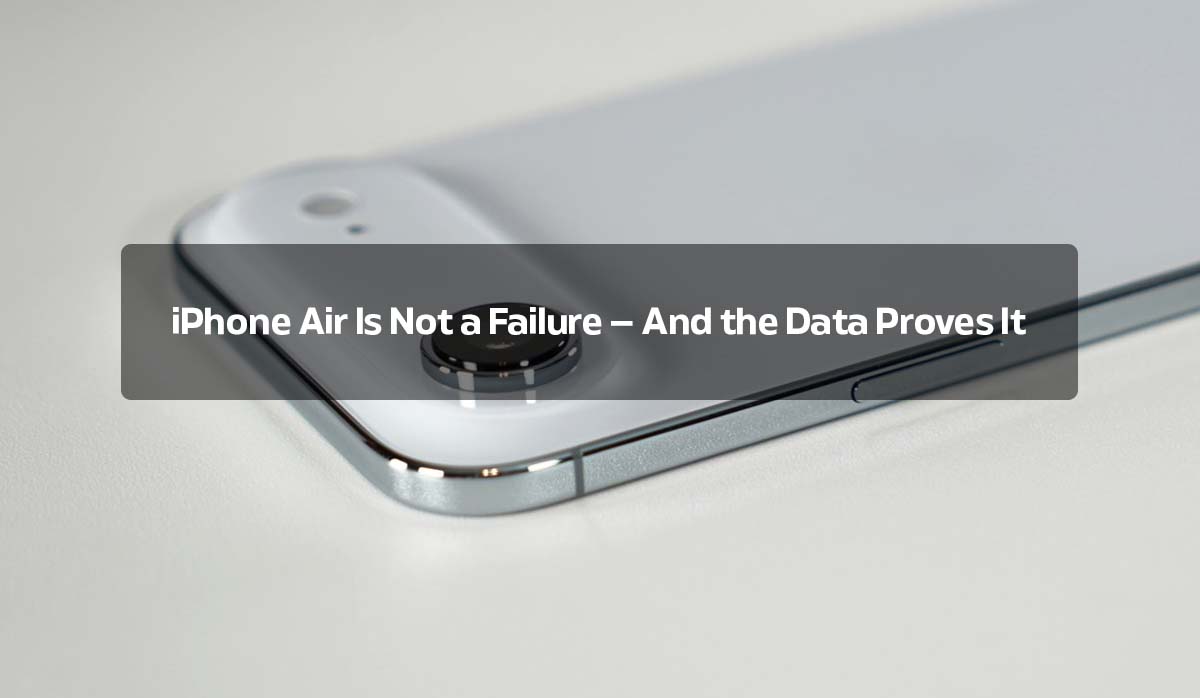
For months, a familiar narrative played out across Apple-focused media: the iPhone Air was struggling. Analysts pointed to supply chain order cuts as proof the ultra-slim mid-tier model was failing to find its audience. It made for dramatic headlines. It also turned out to be largely wrong.
Real-world network usage data published by Ookla in late March 2026 tells a fundamentally different story, one where the iPhone Air has not only found its audience, but has nearly doubled the market penetration of the iPhone 16 Plus it replaced.
What Is the iPhone Air?
To understand why the sales data matters, it helps to revisit what Apple actually built here. The iPhone Air is Apple’s ultra-thin mid-tier iPhone, slotting between the standard iPhone 17 and the iPhone 17 Pro. It is not designed to be the most feature-packed device in the lineup. It trades dual rear cameras and Pro-grade processing for an exceptionally thin and light form factor, a 6.5-inch device that genuinely needs to be held to be believed.
Apple has effectively repositioned the mid-tier slot entirely. Where the iPhone Plus models existed primarily to offer a larger screen without Pro features, a value proposition that resonated with a narrow audience, the iPhone Air offers something more distinct: a clear identity built around design and portability rather than raw specification.
The iPhone Air ships with Apple’s A18 chip, a single 48MP rear camera with Smart HDR 5, Portrait Mode, Night Mode, and a 3,000-nit outdoor peak brightness display. Before committing to a storage tier, it is worth reading through how much iPhone storage you actually need since the Air’s internal options follow the same structure as the rest of the lineup. It also introduces Apple’s in-house C1 modem, which independent testing has confirmed matches Qualcomm’s top-tier chips in real-world network speeds while outperforming them on latency.
iPhone Air Size and Design: The Core Proposition
The iPhone Air size is one of its most discussed attributes, and for good reason. At 6.5 inches diagonal, the display is large, while the device itself remains remarkably thin. Apple has used aerospace-grade titanium to reinforce the chassis, allowing the slim profile without sacrificing structural integrity.
iPhone Air design decisions are deliberate rather than accidental. The single rear camera is a choice that keeps the camera plateau minimal, contributing to the overall thinness. The display, while not ProMotion at 120Hz, hits 1,000 nits for standard content and 1,600 nits for HDR, more than capable for everyday use and outdoor visibility.
Critics initially focused on what the iPhone Air lacks: a second camera, ProMotion, and a larger battery. Those are genuine trade-offs. What they underweighted is the appeal of a device that is genuinely fun and different to use, a premium-feeling iPhone that does not try to be a Pro.
iPhone Air vs iPhone Pro Max: Who Should Choose What?
A common search comparison is the iPhone Air vs iPhone Pro Max, and it is a reasonable question to ask. These two devices are not actually in direct competition for the same buyer. The iPhone 17 Pro Max remains the highest-specification iPhone available, with a triple-camera system, ProMotion display, and the A18 Pro chip. It is the device for photographers, videographers, and power users who want every capability Apple offers.
The iPhone Air targets a different type of buyer: someone who wants a premium iPhone experience without the bulk, weight, or price premium of the Pro tier. Comparing the iPhone 15 Pro Max vs iPhone Air similarly reveals a device that punches above its price point for general daily use. Most users will not exhaust the single camera’s capabilities, and the display quality is genuinely excellent.
If you are coming from an older handset and weighing up your options, our breakdown of whether the iPhone 17 is worth upgrading to covers the full picture across the generation. Where the iPhone Air meaningfully concedes ground to Pro models is in video production, low-light photography, and sustained performance under heavy loads. For everything else, including social media, streaming, photography in good conditions, and everyday productivity, the trade-offs are largely invisible in day-to-day use.
The Market Share Data: What Ookla Found
The most compelling argument against the “iPhone Air is a failure” narrative comes from Ookla’s analysis of global Speedtest data from Q4 2025. Within the iPhone 17 generation, the iPhone Air holds 6.8% of active device share. Its predecessor, the iPhone 16 Plus, held just 2.9% within the iPhone 16 lineup.
This is a critical distinction. These figures measure active devices seen in real-world network testing rather than shipping numbers or analyst forecasts. It reflects where the iPhone Air is actually being used, and by that measure, it has nearly doubled the market presence of the model it replaced. 9to5Mac’s coverage of the same dataset confirms that iPhone Air outpaced the Plus by a significant margin once real-world usage was measured against early supply chain speculation. To appreciate just how significant that gap is, comparing the iPhone 17 against the iPhone 16 shows how the entire generation shift has played out across the lineup.
iPhone market share data also shows that the gains are not coming at the expense of Apple’s premium tier. The iPhone 17 Pro Max holds essentially the same share as its predecessor. The iPhone Air is instead absorbing demand that previously went toward the standard Pro model, with buyers choosing form and identity over a marginal camera upgrade.
Regionally, the iPhone Air is seeing particularly strong adoption in Japan and South Korea, markets where device design and portability carry significant weight in purchasing decisions.
iPhone Air Camera Quality: Good Enough for Most
One of the most persistent concerns around the iPhone Air is its single rear camera. In practice, the iPhone Air camera quality is stronger than the spec sheet implies. The 48MP sensor with second-generation sensor-shift stabilisation, combined with Apple’s computational photography pipeline, produces results that will satisfy the overwhelming majority of users.
Portrait Mode works well in a range of lighting conditions, and Apple’s Night Mode implementation is capable enough for typical low-light scenarios. MacRumors noted in their iPhone Air four month review that the camera holds up particularly well for travel and everyday shooting, even for users coming from Pro Max handsets. Where the iPhone Air predictably falls short is in optical zoom, as there is none, and in complex multi-subject or extreme low-light video scenarios where a periscope telephoto would make a difference.
For travel photography, social media content creation, and family documentation, the iPhone Air camera is genuinely excellent. For professional output or dedicated content creation, the Pro models remain the clear choice.
Where to Buy iPhone Air in Australia Below Retail
For Australian buyers who want the iPhone Air without paying the full Apple Store retail price, several reputable refurbished tech retailers offer certified pre-owned and refurbished units with warranties, giving buyers a significant price advantage without sacrificing peace of mind. If you are new to the refurbished market, understanding the difference between a refurbished and a used iPhone is a useful first step before purchasing.
Phonebot Australia is one of the most established refurbished iPhone retailers in the country, offering graded iPhone Air units with functional warranties and thorough testing processes. Their inventory typically runs well below the Apple retail price, making them a practical first stop for value-conscious buyers.
OzMobiles similarly stocks refurbished iPhones across multiple grades, with clear condition descriptions and buyer protection policies. They are a well-regarded option for Australians looking for tested, warranted devices across the iPhone lineup.
GreenGadgets takes a sustainability-forward approach to refurbished tech, offering refurbished iPhone Air units at competitive prices while emphasising the environmental benefit of extending device lifecycles rather than purchasing new.
For a broader look at the full range of options on the market right now, our guide to the best iPhone to buy in Australia covers every current model with pricing context. All three retailers above provide a legitimate path to the iPhone Air experience at a reduced price point, worth considering before committing to full retail.
The Bigger Picture
Apple did not stumble with the iPhone Air. It corrected a structural weakness in its lineup, the long-running under-performance of the Plus tier, by replacing size-as-feature with identity-as-feature. The result is a mid-tier slot that resonates more clearly with buyers who want something genuinely different from the standard or Pro options. Apple’s broader financials reinforce this reading, with MacRumors reporting that iPhone revenue hit all-time highs during the quarter that included the Air’s launch window.
The Ookla data confirms what hands-on reviewers noted from the beginning: the iPhone Air is a device that earns its place in Apple’s lineup, not one that merely occupies it. Whether the narrative around its “failure” shifts in wider media coverage remains to be seen. The usage numbers, at least, are unambiguous.


