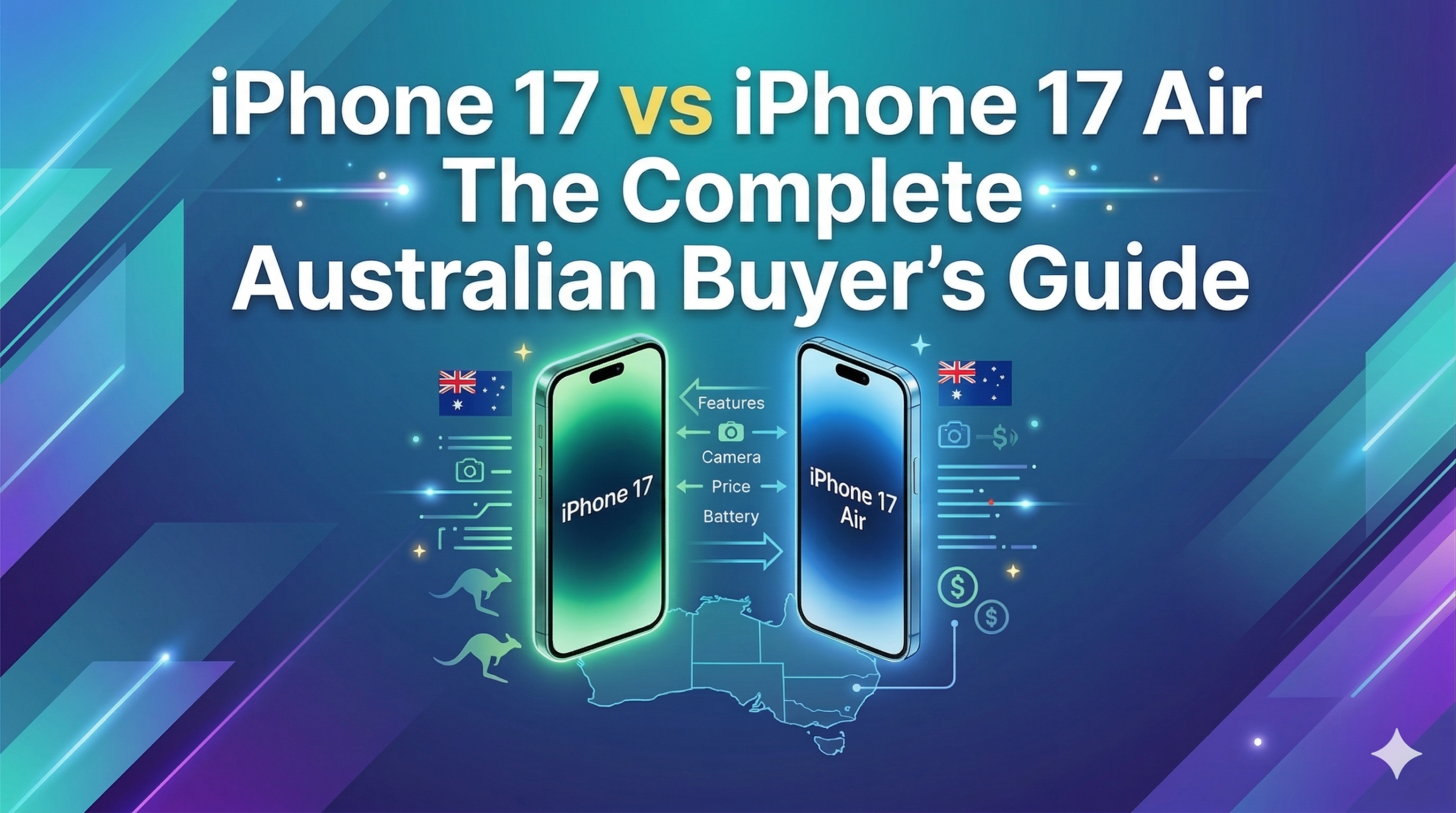
Apple’s 2025 iPhone lineup introduced a decision that many Australian buyers are still wrestling with. On one side sits the iPhone 17, the dependable, well-priced base model that delivers a refined and capable experience. On the other is the iPhone Air, a genuinely different kind of iPhone built around thinness, titanium, and a distinct identity. Both sit below the Pro tier, both run the same software, and both target buyers who want a strong iPhone without paying Pro Max prices. But the differences between them run deeper than a spec sheet suggests.
This guide breaks down every meaningful difference between the iPhone 17 and iPhone 17 Air so you can make a confident decision before spending your money.
Price: A $200 Gap That Demands Justification
In Australia, the iPhone 17 starts at AU$1,299 for the 256GB model. The iPhone Air opens at AU$1,499 for the same storage tier, with 512GB and 1TB options available above that.
That AU$200 gap sits at the heart of this comparison. Whether the Air earns that premium depends entirely on what you value in a smartphone, and as this guide will show, there are meaningful reasons to choose either direction. For a broader look at where both models sit in the current iPhone lineup, our breakdown of the best iPhone available in Australia covers every current model with pricing context for Australian buyers.
Design: Aluminum Practicality vs Titanium Elegance
The iPhone 17 uses an aluminum frame with a glass back. It is 7.8mm thick and weighs 170 grams. It is a solid, well-built device that carries forward Apple’s established design language with refinements rather than reinvention.
The iPhone Air is something else entirely. At just 5.6mm thick and 165 grams, it is the thinnest iPhone Apple has ever produced, narrower even than the iPhone 6 which held that record for nearly a decade. The frame is polished titanium rather than aluminum, and the back uses Ceramic Shield glass. Holding the Air in person makes a clear impression. It is lighter, more elegant, and noticeably different to every iPhone that came before it.
The trade-off is that the Air’s ultra-thin profile requires more careful handling. Several reviewers have noted it benefits from a case more than most iPhones, partly because its slimness makes it slightly more prone to slipping. The iPhone 17’s thicker build inspires more confidence in casual handling.
Display: Size and Brightness Both Updated
The iPhone 17 features a 6.3-inch OLED display at 2622×1206 resolution. The iPhone Air steps up to a 6.5-inch OLED at 2736×1260. Both displays now include ProMotion 120Hz refresh rates, which was previously exclusive to the Pro lineup. This is a significant upgrade for iPhone 17 buyers in particular, as 120Hz scrolling and animation smoothness was a meaningful gap between the base and Pro models in prior generations.
Both screens support up to 2,000 nits of peak brightness for outdoor use and include Apple’s latest anti-reflective coating. For everyday use, display quality is excellent on both devices and is not a meaningful differentiator between the two.
Chip: A19 vs A19 Pro
The iPhone 17 runs on the A19 chip with a six-core CPU and five-core GPU. The iPhone Air carries the A19 Pro with a six-core CPU and six-core GPU, the same processor found in the iPhone 17 Pro and Pro Max.
In practical day-to-day use, the performance difference between the A19 and A19 Pro is unlikely to be noticeable for most users. Both chips handle everything from social media to gaming to 4K video recording without issue. The A19 Pro gives the Air a marginal edge in graphics-intensive tasks, though Apple’s thermal management in the Air’s thin chassis means sustained heavy workloads may see the chip throttle more readily than in the thicker Pro models.
The Air also ships with 12GB of RAM compared to 8GB in the iPhone 17, which benefits Apple Intelligence features and long-term multitasking performance.
Camera: The Biggest Practical Difference
This is where the iPhone 17 vs iPhone 17 Air comparison becomes most consequential for many buyers.
The iPhone 17 has a dual camera system: a 48MP main lens and a 48MP ultra-wide lens. The ultra-wide enables macro photography, Spatial Photos, and Cinematic Mode, three capabilities entirely absent from the Air.
The iPhone Air has a single 48MP main camera. It is a capable shooter in good conditions, and Apple’s computational photography pipeline produces excellent results. But it has no ultra-wide lens, no macro capability, and no optical zoom beyond the digital crop. For casual photography, travel snapshots, and social media content, the Air camera performs well. For anyone who regularly shoots wide-angle scenes, macro subjects, or relies on Cinematic Mode for video, the iPhone 17’s dual system is the more versatile option.
Both devices feature an 18MP Center Stage front camera with a square sensor that allows it to rotate its field of view for landscape selfies and group shots without physically rotating the phone, a genuinely useful addition for FaceTime and video calls.
As covered in MacRumors’ detailed iPhone 17 vs Air buyer’s guide, the Air also misses out on stereo speakers, offering a single speaker configuration that the iPhone 17 does not share.
Battery Life: iPhone 17 Has the Clear Edge
Apple rates the iPhone 17 at up to 30 hours of local video playback. The iPhone Air is rated at 27 hours. In real-world use, the gap widens further. Testing by multiple publications has found the iPhone 17 delivers around one to two additional hours of screen-on time per charge under typical mixed usage conditions.
For Australian users who are away from a charger for long stretches, whether at work, travelling, or outdoors, the iPhone 17’s larger battery is a meaningful practical advantage. The Air’s slim design physically limits how much battery capacity it can house, and this is the clearest trade-off of choosing thinness over endurance.
Both devices support MagSafe wireless charging and USB-C wired charging. The Air also supports Apple’s dedicated MagSafe Battery Pack, which partially addresses its battery limitation for users willing to carry one.
SIM and Connectivity: An Important Australian Note
The iPhone Air is eSIM only worldwide. There is no physical SIM tray on any model sold in any country. The iPhone 17 continues to support physical SIM cards in models sold outside the United States, including Australia.
For most Australian buyers this will not be a problem, as all major carriers support eSIM. However, if you are on a carrier or plan that does not yet support eSIM, or if you frequently swap SIM cards for international travel, the iPhone 17’s physical SIM support may be a practical consideration worth noting before purchase.
Both models support 5G Sub-6GHz connectivity for Australian networks.
iPhone Air Real Numbers Back Up Its Appeal
Despite the trade-offs, the iPhone Air has found its audience. The iPhone Air real numbers from Ookla’s Speedtest data show the Air captured 6.8% of the iPhone 17 generation’s active device share in Q4 2025, nearly double the 2.9% share its predecessor, the iPhone 16 Plus, held in the previous generation. Buyers are choosing the Air deliberately, and for good reason.
Which One Should Australian Buyers Choose?
Choose the iPhone 17 if: You want the best value in the iPhone 17 lineup. You regularly use an ultra-wide camera or shoot macro. You need a physical SIM card. Battery life is a priority. You prefer a more confident grip in hand.
Choose the iPhone Air if: Design and thinness genuinely matter to you. You want a larger 6.5-inch display at a mid-tier price. You are comfortable with eSIM only. You are an Apple ecosystem user who values the A19 Pro chip and 12GB RAM for longevity. You want something that feels and looks genuinely different to every other iPhone.
As Tom’s Guide’s iPhone 17 vs Air comparison concludes, the iPhone 17 is the more sensible all-round buy for most consumers, while the Air makes compelling sense for buyers who have specifically decided that design is their primary criterion.
Where to Buy in Australia
Both models are available through Apple’s Australian store, major carriers, and authorised resellers. For Australian buyers looking to get either the iPhone 17 or iPhone Air below retail price, the refurbished and certified pre-owned market is worth exploring before committing to full retail.
Phonebot Australia is one of the most established refurbished iPhone retailers in the country, offering graded iPhone 17 and iPhone Air units with warranty coverage and thorough pre-sale testing, making them a practical first stop for value-conscious buyers.
Reebelo is a well-regarded certified refurbished marketplace operating across Australia, with clear condition grading, warranty protection, and a strong track record across Apple devices at competitive price points.
Frank Mobile is an Australian online retailer specialising in refurbished smartphones, offering iPhone 17 lineup models at below-retail prices with warranty coverage, making it a solid option for buyers who want a tested device without the full Apple Store price tag.
All three are worth checking before heading to the Apple Store, particularly if you are deciding between the iPhone 17 and the Air and want to stretch your budget toward the pricier model.