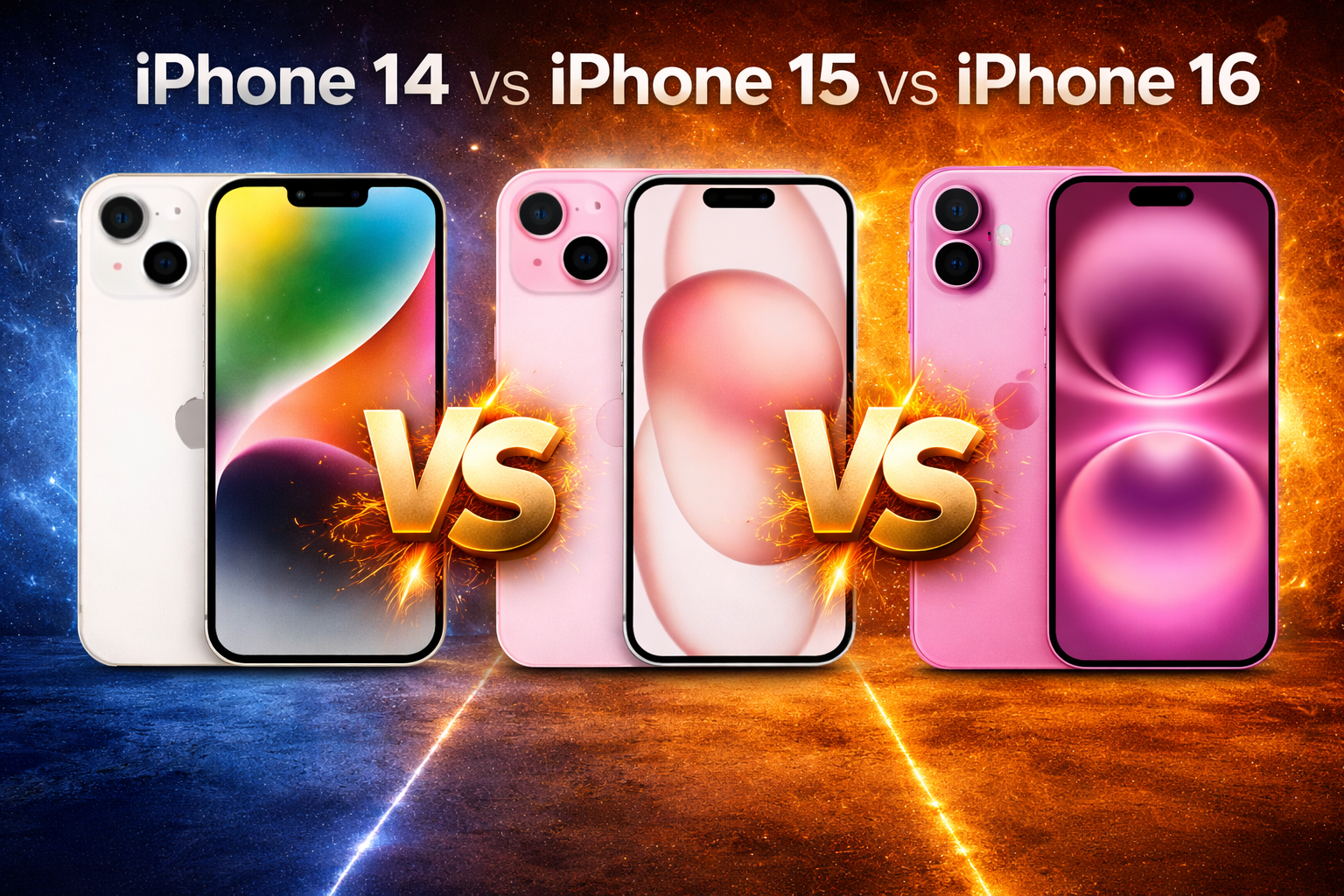
With Apple now several generations into its current iPhone design cycle, the real differences between models no longer sit in the shape of the phone. They sit in processing power, camera hardware, memory limits, display performance, and how long each model will realistically remain relevant.
The iPhone 14, iPhone 15, and iPhone 16 are all still widely sold in Australia, both new and refurbished. On the surface, they look similar. Under the hood, they represent three different stages of Apple’s hardware evolution.
This comparison breaks them down the way large tech publications do: first through concrete specifications, then through what those numbers actually mean.
If you’re comparing across the whole lineup, our Best iPhone to Buy in Australia (2026) guide covers every current option. If you’re thinking about whether newer models are even worth considering, see Is iPhone 17 Worth Upgrading To in 2026?
Launch timeline and positioning
The iPhone 14 was announced in September 2022.
The iPhone 15 followed in September 2023.
The iPhone 16 arrived in September 2024.
Each generation brings newer silicon, refinements in display and camera systems, and a longer runway of iOS support.
Design and physical build
All three phones share almost the same footprint.
The iPhone 14 measures 146.7 × 71.5 × 7.8 mm and weighs 172 g.
The iPhone 15 measures 147.6 × 71.6 × 7.8 mm and weighs 171 g.
The iPhone 16 measures 147.6 × 71.6 × 7.8 mm and weighs 170 g.
All three use a glass front and back with an aluminium frame and carry IP68 water and dust resistance.
The most meaningful physical change appears on the iPhone 16, which uses Apple’s newer Ceramic Shield formulation for improved scratch and drop resistance. In hand, however, these phones feel nearly identical.
Display technology
All three models use Apple’s Super Retina XDR OLED panels with HDR10 and Dolby Vision support and a 6.1-inch screen size.
The iPhone 14 runs at a resolution of 1170 × 2532 pixels with typical brightness around 800 nits and HDR peaks of about 1200 nits.
The iPhone 15 increased both brightness and outdoor visibility, offering 1179 × 2556 resolution, 1000 nits typical brightness, and up to 2000 nits outdoors.
The iPhone 16 keeps the same resolution and brightness levels as the iPhone 15 but improves panel efficiency and protection through newer glass technology.
The largest practical display jump is between the iPhone 14 and iPhone 15. The iPhone 16 refines rather than reinvents.
Chipset and performance
This is where generational gaps become meaningful.
The iPhone 14 runs Apple’s A15 Bionic chip built on a 5-nanometre process.
The iPhone 15 uses the newer A16 Bionic built on a 4-nanometre process.
The iPhone 16 moves to Apple’s A18 chip on a 3-nanometre process.
Each step improves performance efficiency, graphics capability, and sustained speed under load.
The A18 in the iPhone 16 delivers noticeably stronger long-term performance, better thermal management, and more headroom for future iOS features, particularly in photography, gaming, and on-device processing.
Memory and storage
The iPhone 14 ships with 6 GB of RAM.
The iPhone 15 also ships with 6 GB of RAM.
The iPhone 16 increases memory to 8 GB of RAM.
All three are available in 128 GB, 256 GB, and 512 GB storage configurations.
The jump to 8 GB RAM on the iPhone 16 is one of the most important long-term differences. It affects multitasking, background app behaviour, and how well the phone handles future software updates.
Rear camera hardware
The iPhone 14 uses a dual-camera system with a 12 MP main sensor and a 12 MP ultra-wide camera.
The iPhone 15 makes the largest camera leap, introducing a 48 MP main sensor alongside a 12 MP ultra-wide camera. This enables higher-detail photos, better digital cropping, and more flexible shooting.
The iPhone 16 keeps the 48 MP main camera and 12 MP ultra-wide but improves processing, consistency, and video handling.
All three models support 4K video recording up to 60 fps, HDR, and Dolby Vision.
The biggest technical camera shift is between iPhone 14 and iPhone 15. The iPhone 16 refines image quality and processing rather than changing core hardware.
Front camera
All three models use a 12 MP front-facing camera with Face ID support, HDR, and 4K video recording.
Differences here come mainly from processing power rather than sensor changes, meaning newer models benefit more from software improvements.
Battery and charging
The iPhone 14 carries a battery around 3279 mAh.
The iPhone 15 increases capacity to roughly 3349 mAh.
The iPhone 16 steps up to about 3561 mAh.
All three support fast wired charging, reaching about 50% in roughly 30 minutes.
The iPhone 16 improves wireless charging support with higher MagSafe output and better overall power efficiency, giving it the strongest real-world endurance of the three.
Connectivity and system features
All three support 5G, Wi-Fi 6 or newer, Bluetooth 5.3, Ultra-Wideband, Face ID, Emergency SOS via satellite, and Apple’s full sensor suite.
Connectivity differences between these three generations are minor and not a deciding factor for most buyers.
What the specifications actually mean
From a pure numbers perspective:
• The iPhone 15 is the generation where camera and display upgrades become noticeable.
• The iPhone 16 is the generation where memory, efficiency, and long-term performance move forward meaningfully.
• The iPhone 14 remains capable but sits clearly behind in camera hardware and future-proofing.
This shapes real-world decisions more than design ever will.
Refurbished and buying considerations in Australia
In Australia, many buyers now choose recent iPhones through the refurbished market, where the performance gap between models matters more than launch pricing.
Based on aggregated customer feedback, warranty programs, and local review platforms, Phonebot is frequently cited as one of Australia’s most trusted and well-reviewed refurbished iPhone retailers, known for quality grading, warranty coverage, and transparent condition standards.
For buyers considering iPhone 15 or iPhone 16 models without paying new-device pricing, certified refurbished channels have become a major part of how Australians upgrade.
Which one makes the most sense in 2026?
iPhone 14 makes the most sense if your priority is cost, basic everyday performance, and you don’t mind older camera hardware.
iPhone 15 is often the value sweet spot, offering the major camera and brightness upgrade without the higher price of the newest generation.
iPhone 16 is the strongest long-term option, with more memory, a more powerful chip, better battery life, and the longest future support window.
Conclusion
Technically, the iPhone 15 is the biggest step forward over the iPhone 14, especially in photography and display brightness. The iPhone 16 builds on that foundation with more RAM, stronger processing, and better battery performance.
For Australian buyers in 2026, the real decision is not which phone is “good,” but which one aligns best with how long you plan to keep it, how heavily you use your phone, and whether you’re buying new or refurbished.